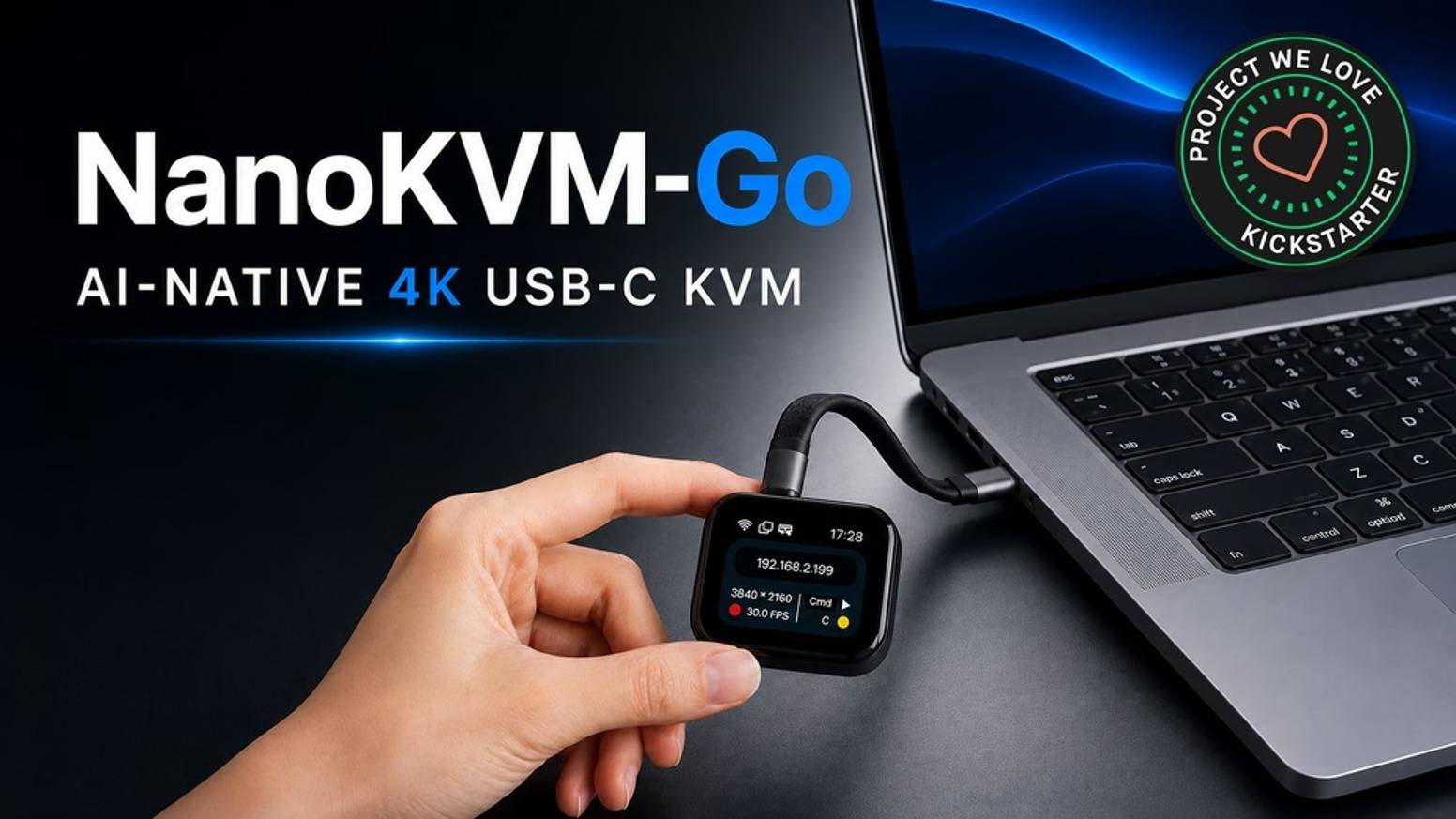
Control any USB-C device from anywhere with one cable. Empower AI Agent with full screen memory and control. Work Remote, Flow Smart.
NanoKVM-Go solves the scenario where software-based remote control fails: a Mac freezes, a mini PC needs a hard reboot, or an AI agent needs hardware-level screen access that no remote desktop app can provide. A single USB-C cable carries video, audio, keyboard, mouse, and power to the target, and the user opens a web browser on any device to see the screen, move the mouse, type, reboot, or control the machine— no drivers, no client app, no dedicated software required on the target. Video streams at up to 4K@45fps or 2K@90fps over dual-band WiFi 6 with up to 286 Mbps throughput and local-network latency as low as 60–90ms, preserving the clarity of Retina displays and dense code on remote sessions. Tailscale integration provides secure remote access from anywhere with zero port forwarding or VPN configuration. A second USB-C port extends utility: PD pass-through keeps the target device charged during long sessions, a finger-robot module physically presses power buttons for out-of-band reboot of frozen machines, and remote OS installation boots from a virtual USB drive through the browser. The entire KVM measures approximately 45×40×15mm and draws 1.6W— roughly a quarter the volume and half the power of the nearest 4K KVM competitor— with built-in magnets for attachment to a PC case or the back of a phone. Hardware-level control means physical disconnection is absolute: when the cable is unplugged, the session is gone with no residual access, no background process, and no trace. Open-source by design and AI-native from the ground up, NanoKVM-Go is built by Sipeed, the team behind one of the most popular open-source KVM platforms.