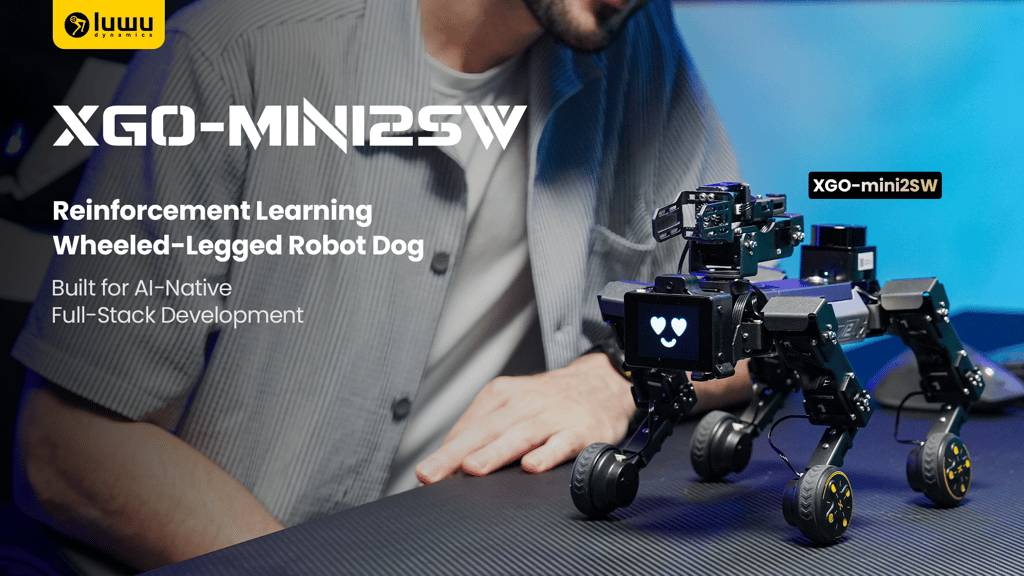
Powered by Raspberry Pi CM5 for multimodal AI, vibe coding, and open-source development — learn, code, build, and explore AI robotics.
XGO-mini2SW is a wheeled-legged robot dog that moves beyond hard-coded gaits to AI-driven autonomous learning, built on three prior generations of successfully funded XGO robots. Powered by reinforcement learning, it adapts to changing environments, maintains balance, and recovers from unexpected disturbances in real time rather than relying on pre-scripted motions. An open-source Sim-to-Real pipeline simplifies the deployment path for developers, moving RL skills from simulation to the physical robot with minimal setup and tuning. Mobility combines the speed of wheels on smooth surfaces with 12-DoF legs that climb slopes and navigate complex terrain, packaged in a custom ultra-compact FOC hub-wheel module that merges motor, drivetrain, and wheel into one unit; a few screws switch between wheeled and legged configurations in minutes. The robot’s brain is a Raspberry Pi CM5 paired with an HD camera and vision-language models that recognize objects, understand scenes, and describe what it sees in near real time, with LiDAR adding real-time spatial perception and precise target tracking. A 4-DoF robotic arm lets the robot interact with objects and execute physical tasks, and a natural-language AI interface understands the robot’s codebase, writes and debugs software, and deploys it directly — turning an intent described in words into motion. The platform is fully open-source across Blockly, Python, C++, serial communication, and ROS, and includes a personalized AI companion layer with expressive animations, unique voice styles, and long-term memory of user preferences. A sibling model, XGO-Ranger, shares the same core architecture in a simpler, more accessible form. LuwuDynamics, founded in 2020 by a team from the State Key Laboratory of Robotics and System at Harbin Institute of Technology, built the XGO series to bridge cutting-edge robotics theory and practical education.